

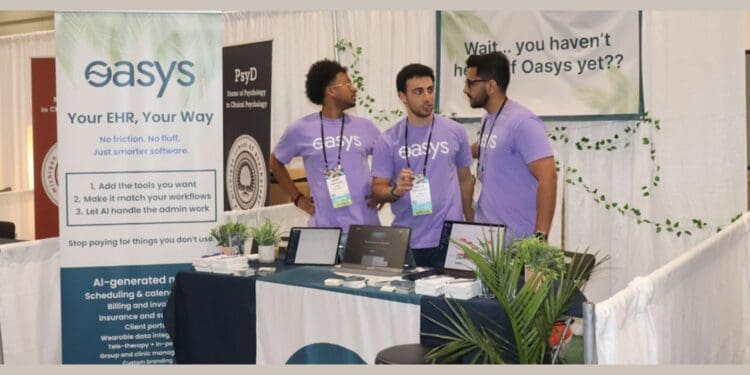
New York-based Oasys Health, founded by an Egyptian-led team, has raised $4.6 million to push forward its vision of rebuilding the infrastructure behind mental health care.
New York-based Oasys Health, founded by an Egyptian-led team, has raised $4.6 million to push forward its vision of rebuilding the infrastructure behind mental health care.
The funding includes a $4 million seed round led by Pathlight Ventures, with support from Twine Ventures and Better Ventures, alongside an earlier $600,000 pre-seed round backed by 1984 Ventures.
The new capital positions Oasys to move beyond early validation and into deeper product and market expansion.
The company plans to further develop its AI-first mental health platform, strengthen integrations with wearable devices and consumer health applications, and grow its engineering and data science teams.
On the go-to-market side, Oasys is targeting tighter partnerships with clinics, behavioral health providers, managed service organizations, and institutions such as universities that are investing in long-term mental health infrastructure for students.
Founded in 2024 by Hashem Abdou, Raffay Rana, and Dawit Fasika, Oasys is building what it describes as an operating system for modern mental health care.
Instead of focusing on a single workflow, the platform automates much of the administrative and clinical overhead that weighs down providers.
This includes documentation, clinical notes, billing, scheduling, and insurance reimbursement processes. The system also connects directly to consumer health tools such as Apple Watch, Oura Ring, Strava, and Flo, allowing clinicians to securely access real-time physiological data spanning sleep, activity, heart rate, glucose levels, and menstrual cycles.
Abdou has framed the raise as a step toward reshaping how mental health care is delivered by making it more personalized, data-informed, and easier to access.
From an industry perspective, this shows a broader push to move mental health infrastructure away from fragmented systems that were never designed for continuous data streams or outcomes-based care.
Legacy electronic health records often struggle to support mental health providers, especially as care models shift toward hybrid, remote, and longitudinal treatment.
Pathlight Ventures views Oasys as an attempt to define a new layer in mental health technology by consolidating data, workflows, and analytics into a single backbone rather than stacking disconnected tools.
That approach resonates in a sector where clinicians are increasingly burdened by administrative work, and where proof of care effectiveness is becoming more important for payers, employers, and institutions.
Oasys plans to introduce a structured outcomes measurement framework in 2026. The goal is to give clinicians standardized ways to track patient progress and demonstrate the long-term effectiveness of therapy. The company is also aiming to scale its partner network to more than 1,000 enterprise-level mental health organizations.
From a market standpoint, Oasys sits at the intersection of mental health, AI, and connected health data, a space drawing growing investor interest as demand for care rises and provider capacity remains constrained.
The challenge will be execution at scale, particularly in integrating sensitive data sources while maintaining trust, compliance, and clinical relevance.
If the company can balance those demands, it may help set a new reference point for how mental health systems are built and measured in the years ahead.
This post first appeared on Waya Media.
Don’t miss important articles during the week. Subscribe to techbuild weekly digest for updates